Service Hotline:13510328459
 205-206, 2nd Floor, Building 2, Xiazao Village Industrial Zone, Gaofeng Community, Dalang Street, Longhua District, Shenzhen City
Service Hotline:13510328459
205-206, 2nd Floor, Building 2, Xiazao Village Industrial Zone, Gaofeng Community, Dalang Street, Longhua District, Shenzhen City



Time:2026-03-20 Preview:
In the rapidly evolving landscape of healthcare infrastructure, the patient environment has become a focal point for clinical outcomes. Among the most essential components of this environment are hospital privacy curtains. Often referred to as cubicle curtains, these systems are far more than fabric dividers; they are critical tools for infection control, fire safety, and patient dignity.
Whether you are a procurement officer for a multi-state hospital network or a wholesale distributor looking to stock the most reliable products, choosing the right privacy curtains hospital systems requires a deep dive into material science, hardware engineering, and international safety compliance. This 2026 guide provides everything you need to know to make an informed investment.
At its core, a hospital bed privacy curtain serves a purpose far greater than simple room division; it creates a temporary, flexible sanctuary for patients navigating high-traffic, high-stress environments such as Emergency Rooms (ER) and Intensive Care Units (ICU). However, as we move through 2026, the industry definition of "quality" has expanded significantly. It no longer refers solely to the thickness of the fabric, but encompasses a sophisticated integration of advanced textile technologies, including nanocoatings for pathogen resistance and molecularly bonded flame retardants.
The importance of high-tier privacy curtains for hospitals is deeply rooted in patient outcomes. Comprehensive clinical studies have consistently demonstrated that patients who perceive their environment as secure and private experience significantly lower cortisol levels and reduced heart rates, leading to demonstrably faster recovery stages. These curtain systems provide the essential visual and acoustic boundary required for sensitive physical examinations and the highly confidential doctor-patient consultations that form the backbone of ethical medical care. Without this perceived safety, patient satisfaction scores and healing efficiency inevitably decline.
A critical realization for modern procurement officers is that a curtain is only as high-performing as its mounting infrastructure. When sourcing these essential products, one must evaluate the hospital privacy curtain track not as an accessory, but as part of a unified mechanical system. This "system approach" ensures that the hardware and textile work in perfect harmony. If the track system fails due to poor load-bearing engineering, or if the fabric lacks rigorous compliance with local fire codes like NFPA 701, the entire ward’s safety, aesthetic, and operational functionality are compromised. Choosing a synchronized system from a professional manufacturer like Econley ensures that every component—from the reinforced track to the antimicrobial fabric—is optimized for the extreme demands of 24/7 healthcare facility use.
When evaluating different manufacturers and models, four foundational pillars should guide your decision-making process: Fire Safety, Infection Control, Durability, and Aesthetics. In a modern healthcare setting, a hospital bed privacy curtain is a high-performance medical device that must function perfectly under constant use while adhering to strict government regulations. Failing to meet these criteria can lead to failed safety audits or, more critically, compromised patient safety.
In the United States and most international commercial markets, the non-negotiable standard for healthcare textiles is NFPA 701. When sourcing hospital privacy curtains, you must distinguish between "treated" fabrics and "inherent" fabrics. While topically treated curtains meet initial codes, the flame-retardant chemicals can eventually wash out or degrade. Conversely, curtains made from Inherently Fire Resistant (IFR) yarns have safety properties built into the molecular structure of the fiber. These IFR curtains maintain their life-saving integrity even after dozens of high-temperature industrial washes, providing a much higher return on investment and permanent peace of mind.
In an era defined by the threat of antibiotic-resistant bacteria, your privacy curtains hospital choices must act as an active biological barrier rather than just a passive shield. Premium fabrics are now treated with silver-ion technology or specialized antimicrobial agents that actively inhibit the growth of dangerous pathogens like MRSA, E. coli, and C. diff. Because curtains are a high-touch surface for both patients and medical staff, selecting a fabric that self-sanitizes between cleanings is a critical step in reducing Healthcare-Associated Infections (HAIs).
Most modern building and safety codes require a mesh top (usually the top 20 inches of the curtain) to ensure two critical functions: fire sprinkler penetration and unobstructed airflow within the enclosed cubicle. A solid fabric without mesh can create a "tent effect" that traps heat and prevents fire suppression systems from reaching the patient bed. However, the mesh itself must be heavy-duty; selecting a high-tensile strength mesh ensures the curtain does not tear at its highest stress point—the connection to the track—where the most mechanical force is applied during daily operations.
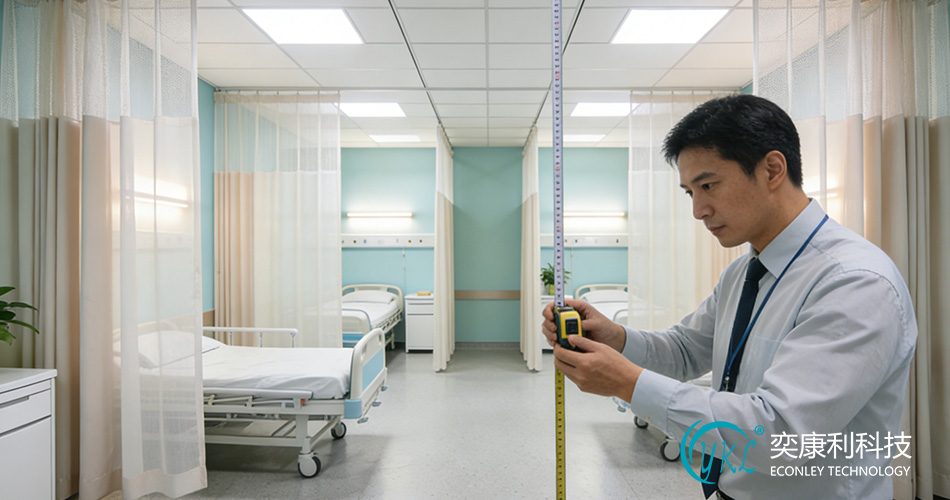
The movement of a curtain determines the efficiency of a medical ward. A jammed or noisy hospital privacy curtain track can delay critical care and disturb resting patients.
While plastic tracks exist, professional-grade commercial projects almost exclusively use extruded aluminum tracks. Aluminum offers:
Structural Integrity: It won't sag over time, even with heavy blackout fabrics.
Corrosion Resistance: Essential for hospital environments that undergo frequent chemical sanitization.
Noise Dampening: Modern tracks are designed with internal glides that operate at decibel levels low enough to keep wards quiet.
Depending on your ward layout, you may require:
U-Shape Tracks: For complete 360-degree bed enclosure.
L-Shape Tracks: Common for corner beds or semi-private rooms.
Suspended Tracks: Used in high-ceiling facilities where the track must hang from a suspension tube to meet functional heights.
For global wholesalers and large-scale medical supply distributors, the primary objective is to deliver a product line that flawlessly balances high-tier clinical performance with long-term cost-efficiency. In a market where margins are tightened by logistics and competition, sourcing directly from a specialized OEM/ODM manufacturer like Econley transforms from a standard procurement choice into a decisive strategic advantage. By bypassing intermediary markups, distributors can secure premium-grade materials that meet the rigorous demands of modern healthcare facilities while maintaining a highly competitive price point.
When procuring hospital privacy curtains in bulk, "one size fits all" is rarely a viable solution. High-value international government tenders and private hospital contracts often mandate highly specific technical requirements, ranging from exact track lengths and specialized mesh densities to proprietary antimicrobial finishes. A factory-direct relationship with Econley empowers distributors with unparalleled flexibility:
Strategic Custom Branding: We provide comprehensive private labeling services, allowing your distribution firm to build brand equity and loyalty by offering a "signature" line of high-quality privacy curtains for hospitals.
Architectural Precision Bending: One of the most significant cost-savers in commercial projects is pre-fabrication. We can provide hospital privacy curtain tracks pre-bent to your client’s specific architectural blueprints. This precision engineering reduces on-site labor hours and eliminates the risk of installation errors, saving thousands in contractor fees.
Total Material Traceability: In the event of a safety audit, having immediate access to raw material certifications is critical. We provide full documentation for NFPA 701 compliance, SGS testing, and ISO standards, ensuring your products pass every inspection with flying colors.
As we look toward the remainder of 2026, the international market for privacy curtains hospital systems is undergoing a profound transformation driven by regulatory shifts and environmental consciousness. Modern procurement is no longer just about immediate utility; it is about aligning with global healthcare sustainability goals while maintaining uncompromising safety standards. Several dominant trends are reshaping how facilities select their partitioning solutions:
Rise of Sustainable and Circular Textiles: There is a surging global demand for eco-friendly, recyclable polyester fabrics that do not sacrifice safety for sustainability. Leading manufacturers are now producing textiles that maintain full IFR (Inherently Fire Resistant) standards while being composed of post-consumer recycled materials, allowing hospitals to reduce their carbon footprint without violating fire codes.
The Shift from Disposable back to Premium Reusable: While single-use disposable curtains gained traction for high-infection zones, 2026 is seeing a strategic return to high-quality reusable privacy curtains for hospitals. Facility managers are recognizing the significantly lower long-term environmental impact and superior "total cost of ownership" offered by durable, antimicrobial fabrics that can withstand 50+ industrial wash cycles.
High-Performance Blackout and Acoustic Privacy: Specialized clinical environments, such as ophthalmology departments, sleep study labs, and premium VIP wards, are increasingly requesting integrated fire-rated blackout curtains. These advanced fabrics provide 99% light blockage and enhanced acoustic dampening, creating the precise environmental control necessary for diagnostic accuracy and deep neurological recovery.
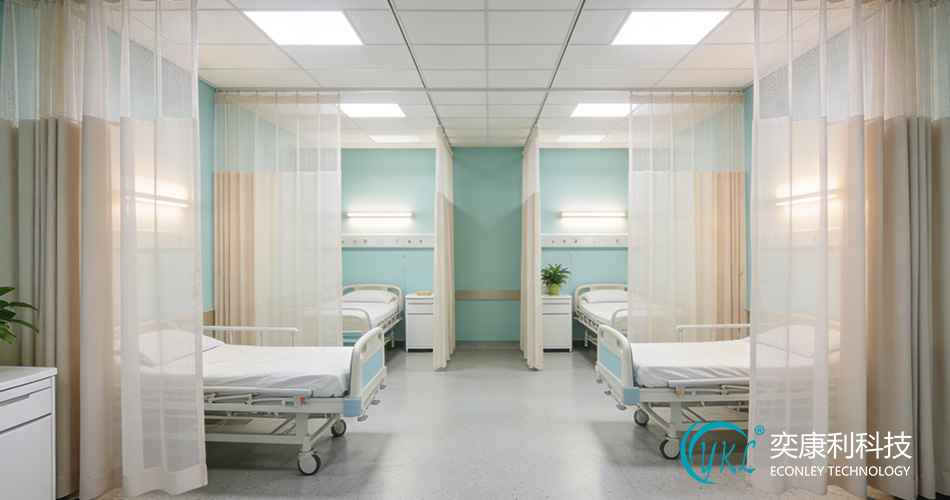
To protect your significant capital investment and ensure the safety of both patients and staff, a rigorous technical maintenance schedule is vital. Even the most advanced hospital privacy curtain track systems are subject to mechanical fatigue over years of 24/7 operational use. Neglecting these small details can lead to costly ward downtime or, worse, functional failure during a medical emergency.
Precision Glide and Roller Replacement: Track rollers are the "engine" of the system. We recommend that hospital curtain track rollers be inspected annually for signs of flat-spotting or axis wear. Replacing worn glides proactively ensures near-silent operation and prevents the "stuttering" effect that can frustrate nursing staff.
Strict Laundering and Sanitization Protocols: To maintain the efficacy of reusable privacy curtains for hospitals, they must be laundered strictly according to the manufacturer’s heat and chemical specifications. This is critical to preserving the antimicrobial and fire-retardant properties of the fabric; improper high-temperature drying can degrade the molecular bonds of IFR yarns over time.
Structural Hook and Hardware Inspection: Periodically ensure that the stainless steel or heavy-duty plastic hooks are not deforming or "opening up." Bent hooks are the primary cause of curtain "snagging," which puts unnecessary lateral stress on the aluminum track and can lead to structural misalignment.
At Econley, we design our hardware for maximum longevity, but regular "preventative health checks" on your track systems will extend their service life by years, ensuring a smooth, professional environment for every patient.
Q1: How to figure hospital privacy curtain width?
A: To ensure full privacy and a "graceful" look, the curtain width should be approximately 10-15% wider than the actual track length. This "fullness" prevents the curtain from being stretched too tight, which can damage the track rollers and create gaps in privacy. For example, if your track is 10 feet long, a 11.5-foot curtain is ideal.
Q2: Where can I rent privacy curtains for hospitals?
A: While some medical equipment companies offer short-term rentals, most healthcare facilities find it significantly more cost-effective to purchase high-quality systems from manufacturers like Econley. Buying allows for better infection control management and customization to your specific facility layout.
Q3: Where to buy hospital privacy curtain tracks?
A: You can buy tracks from specialized medical hardware distributors or directly from manufacturers. Sourcing from Econley ensures you get factory-direct pricing on high-grade aluminum extrusions and pre-bent configurations that meet ISO and SGS standards.
Q4: Are there curtains you can see out of but people can't see in?
A: In a medical setting, this is typically achieved through specialized "one-way" mesh or specific light-filtering fabrics. However, for standard hospital use, most facilities prefer "shadow-proof" fabrics that ensure total visual privacy for the patient while allowing light to filter through the mesh top.
Q5: Why is Econley considered a top choice for B2B wholesalers?
A: Econley specializes in high-volume OEM/ODM production. We provide the full package—from the fire-retardant fabric to the heavy-duty aluminum tracks and rollers. Our global shipping experience and compliance with international fire codes make us a reliable partner for large-scale commercial projects.
 Tel :13510328459
 Email :493432861@qq.com
 Phone :0755-82154850/25907050
 Add:205-206, 2nd Floor, Building 2, Xiazao Village Industrial Zone, Gaofeng Community, Dalang Street, Longhua District, Shenzhen City

About

Products
Cases
News
Contact
 493432861@qq.com